Lighting Built for Function and Visibility
Lighting Installation & Upgrades in Gooding for indoor spaces, outdoor security, shop work areas, and landscape features
Insufficient lighting in work areas forces employees to strain under inadequate visibility, while poorly placed exterior lighting leaves property perimeters vulnerable to security concerns and creates trip hazards after dark. Lighting installation through Charged Up Electric LLC addresses specific visibility needs across residential, commercial, farm, and business properties in Gooding and the surrounding Magic Valley, where outdoor lighting must also withstand seasonal weather exposure and temperature swings. The installation process includes evaluating light levels required for each space, selecting fixtures rated for the environment, and positioning them to eliminate shadows in task areas or dark zones along walkways and building perimeters.
Upgrades to LED lighting reduce energy consumption while delivering higher lumen output than older fluorescent or incandescent systems, particularly beneficial for shops and barns that run lights for extended hours. Security lighting installations incorporate motion activation or photocell controls that respond to ambient light levels, ensuring lights operate only when needed rather than running continuously. Interior lighting improvements involve adding circuits to support increased fixture counts, installing dimmer controls where adjustable light levels improve usability, or replacing outdated fixtures with options that distribute light more effectively across the space.
Schedule a lighting consultation to evaluate your property's visibility requirements and fixture options.
What Proper Lighting Installation Requires
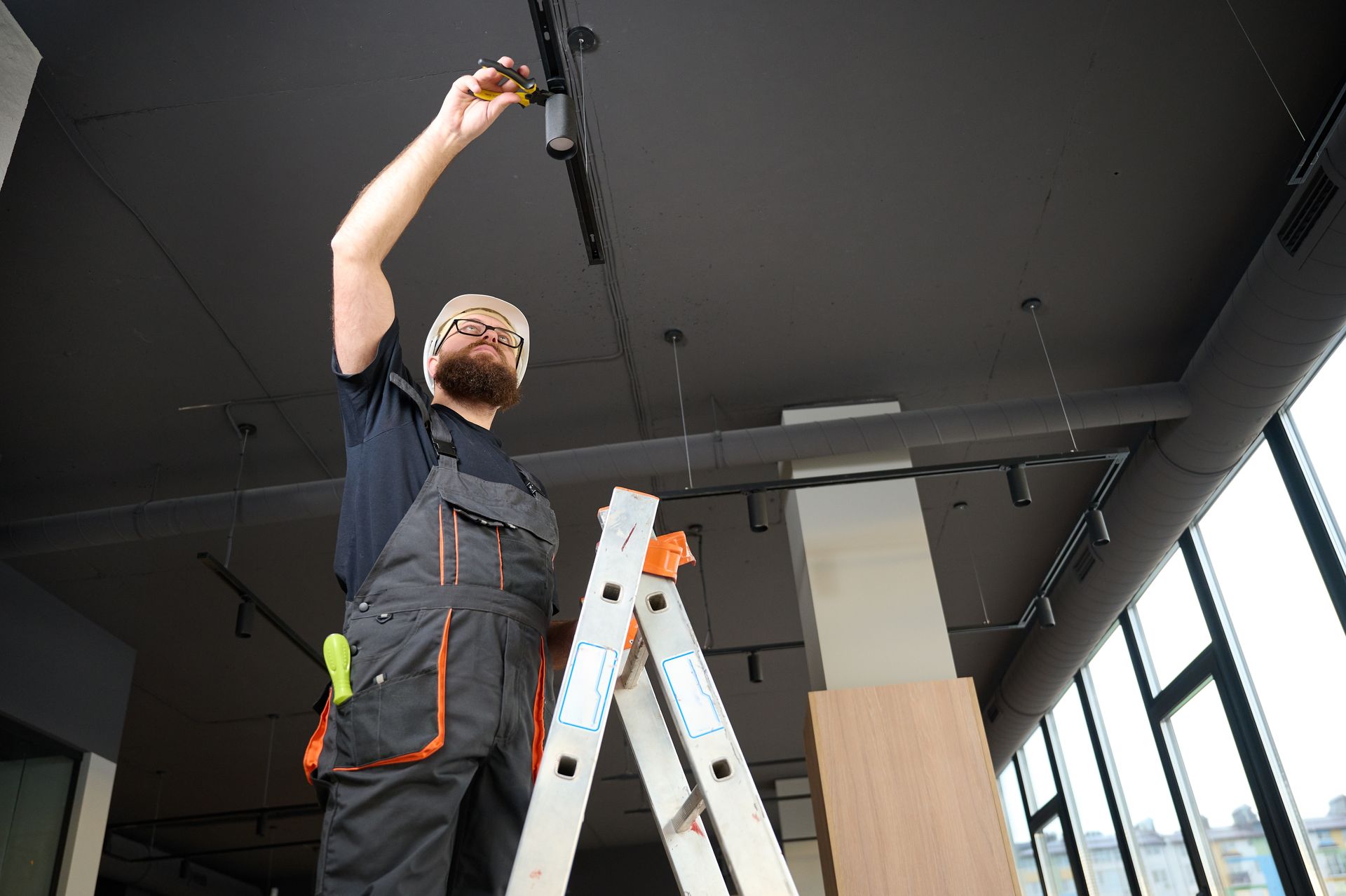
Installation begins with calculating the light output needed for each area based on the tasks performed there, then selecting fixtures with appropriate lumen ratings and beam spreads to cover that space without excessive overlap or gaps. Wiring runs from the panel to each fixture location, with switches and controls positioned for convenient access. Outdoor fixtures require weatherproof enclosures, corrosion-resistant mounting hardware, and wiring methods that prevent moisture intrusion at connection points.
After installation completes, work areas show uniform lighting without harsh shadows that obscure detail, walkways remain visible from entry points to buildings, and landscape features receive accent lighting that highlights architectural or natural elements. Motion-activated security lights respond quickly when activity occurs within their detection range, then shut off automatically after a set interval. LED conversions result in noticeably brighter spaces while reducing the frequency of bulb replacements and lowering energy costs compared to previous lighting systems.
Lighting upgrades can be phased to address priority areas first, with additional circuits and fixtures added as budget allows or as property use changes. Systems are installed with circuit capacity to accommodate future expansion, and control wiring allows for automation integration if you later choose to add programmable or remote lighting management.
Common Lighting Installation Questions
Lighting projects vary based on whether the goal is improving visibility for safety, reducing energy costs, or addressing specific task requirements.
What determines how many fixtures a space needs?
Light level requirements depend on the activities performed in that space, with detailed work requiring higher lumen output per square foot than general circulation areas, and fixture placement affecting how evenly that light distributes across the area.
How does LED lighting compare to older shop fluorescent fixtures?
LED shop lights deliver equivalent or greater brightness while consuming roughly half the wattage, produce less heat, and eliminate the flicker and warmup delay common with fluorescent tubes, particularly noticeable in cold weather when fluorescents struggle to start.
When should exterior lighting include motion sensors versus constant illumination?
Motion activation works well for security lighting and infrequently used areas like side yards or storage zones, while constant lighting suits main entries, loading areas, and pathways in Gooding's rural properties where darkness creates navigation hazards.
Why do landscape lighting installations require low-voltage transformers?
Landscape lighting typically operates at 12 volts for safety in outdoor environments where wiring may be exposed to moisture and physical contact, with transformers stepping down standard 120-volt power to the lower voltage before it reaches the fixtures.
What's involved in adding lighting to existing buildings?
New lighting circuits require running wire from the electrical panel to fixture locations, installing junction boxes for connections, mounting fixtures securely to building structure, and adding switches or controls at accessible locations, with the complexity depending on whether wiring routes through open spaces or finished walls.
Charged Up Electric LLC designs and installs lighting systems for indoor, outdoor, and agricultural applications throughout the Magic Valley. Reach out to discuss your lighting project and review fixture options suited to your property's specific visibility and energy efficiency goals.